The Executive Search Operating System

BY JOSH HERNÁNDEZ

Most founders run their first executive search as a funnel: write the JD, source against it, interview, hire. That model assumes you already know what you need. You almost certainly don’t—not with the precision the market will demand of you.
This four-phase framework for hiring your first executives treats the search as a loop instead, where every conversation sharpens both the target and the pool. It will help you know, at any given week, whether the search is actually working.
Very important note!
The goal of an executive search is not to execute against the initial job description. It is to continuously increase the company’s confidence about what it needs, while simultaneously increasing the quality of the candidate pool.
How to use the framework
Each of the four phases ends with a specific artifact you fill in. If you finish a phase without the artifact, you haven’t finished the phase.
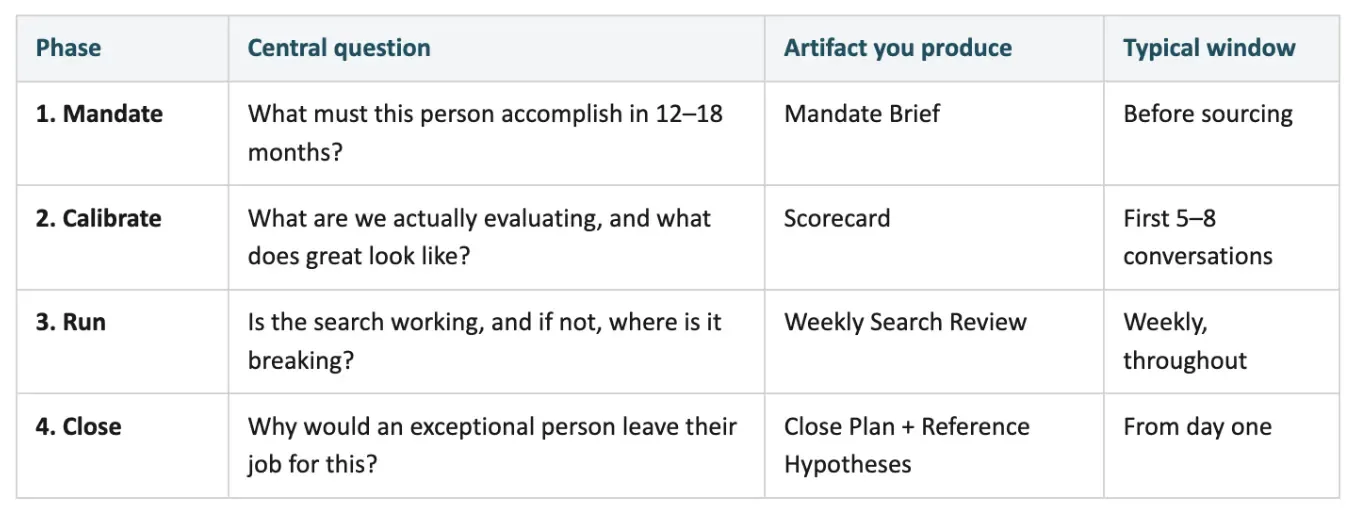
A note on sequence: These phases overlap. Closing starts on day one, not at the offer stage. Calibration doesn’t stop after the eighth conversation. The numbering describes where each discipline is introduced, not a gate you pass through once.
Phase 1: Mandate
Define the job before you define the person.
Before you talk about archetypes, pedigree, or profiles, you should answer one question: what does this person need to accomplish in the first 12–18 months?
A Head of Engineering hired to take a team from 8 to 30 is a fundamentally different person from one hired to fix reliability, one hired to recruit distinguished-level ICs, or one hired to increase an existing 50-person org’s product velocity. The mandate generates the candidate profile. Not the other way around.
You also need to separate must-haves from proxies. Executive searches get narrow — and then stall — because founders turn proxies into requirements:
“They need to have worked at Stripe.”
“They need to have managed 100 people.”
“They need to be a VP already.”
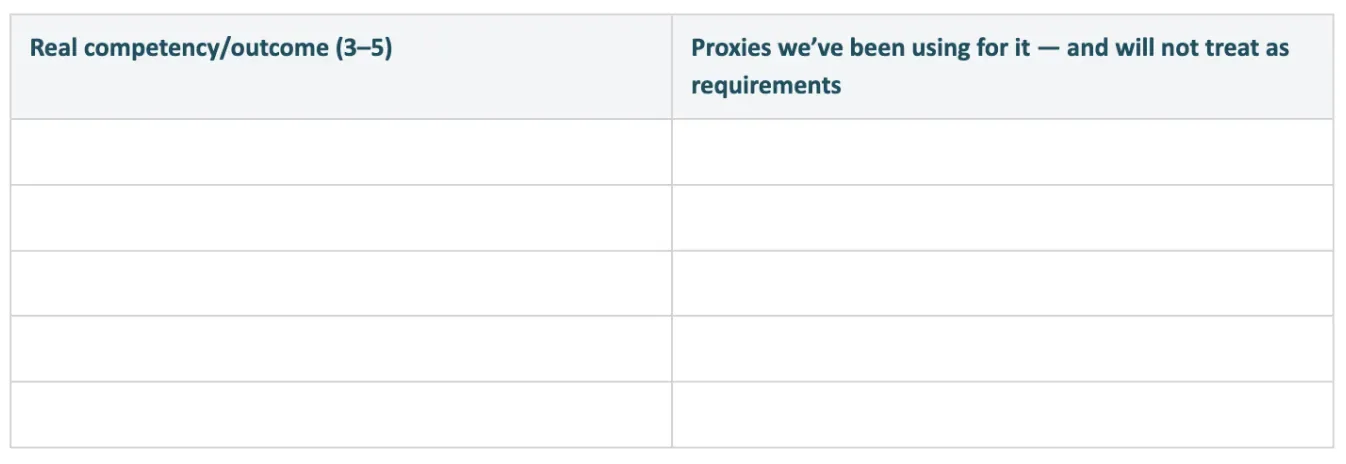
None of those are outcomes. They are shorthand for outcomes. Force the translation by naming 3–5 real competencies or results, then list which of your stated criteria are merely proxies for them. Proxies are useful for sourcing and dangerous for deciding.
Test for this phase: If two people on your team wrote the mandate independently, would they name the same three outcomes? If not, you are not ready to source.
Artifact for Phase 1: Mandate Brief
Fill this page in with the hiring executive before any sourcing begins.
For a 12–18 month mandate, what must be true when this person has succeeded? What are we explicitly not hiring for?
Phase 2: Calibrate
Before the first real candidate enters the process, agree on what you are evaluating and how. Without this, the search degenerates into “I liked them” versus “I didn’t” — which is unarguable, unteachable, and impossible to delegate.
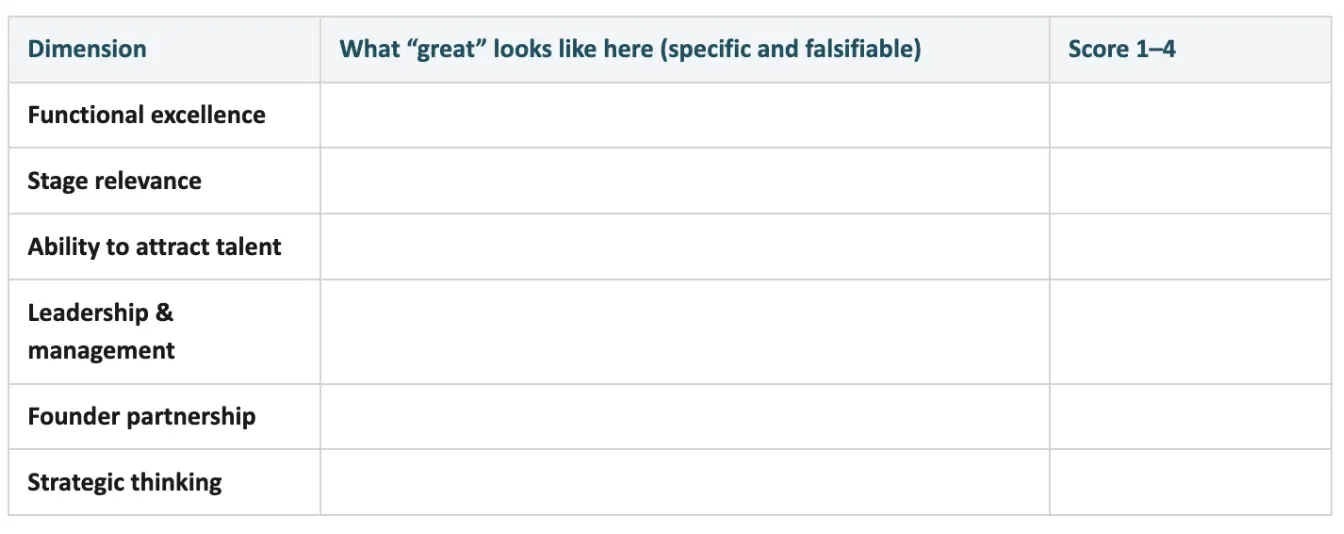
A workable set of dimensions for most leadership roles:
Functional excellence
Stage relevance
Ability to attract talent
Leadership and management
Founder partnership
Strategic thinking
The dimensions matter less than the definitions. For each one, write down what great actually looks like at your stage, in your context. “Strong leader” is not a bar. “Has personally recruited and retained three or more senior engineers who are still there two years later” is a bar.
Treat the first sprint as calibration
Don't score your first five to eight hiring-manager conversations as successes or failures. They are instrumentation. After that batch, stop and ask three questions:
What have we learned about what we actually want?
Which archetype is outperforming and why?
Which of our original assumptions turned out to be wrong?
Then revise the Mandate Brief. A search that never revises its brief is either extraordinarily lucky or not paying attention.
Artifact for Phase 2: Scorecard
Agree on this before the first candidate. Score 1–4; require written evidence, not adjectives.
Calibration checkpoint: Run this after conversation 5–8.
What did we learn? Which archetype is outperforming? Which assumption was wrong? What changes in the Mandate Brief as a result? Put a date on it now so it actually happens.
Phase 3: Run
Searches rarely die because the market is impossible. They die because feedback slows down, the CEO gets distracted, or the target subtly changes and nobody says so out loud. The fix is unglamorous: a standing weekly meeting between the recruiter and the hiring executive, with a fixed agenda. Additionally, the recruiter and hiring manager must actively partner with each member of the interview panel to ensure full alignment on hiring goals across the entire team. But what happens when the hiring executive is too busy? If you can’t find a worthy proxy decision-maker and the hiring executive isn’t available, then this role/search isn’t a real priority. Put frankly, you’re not ready to recruit.
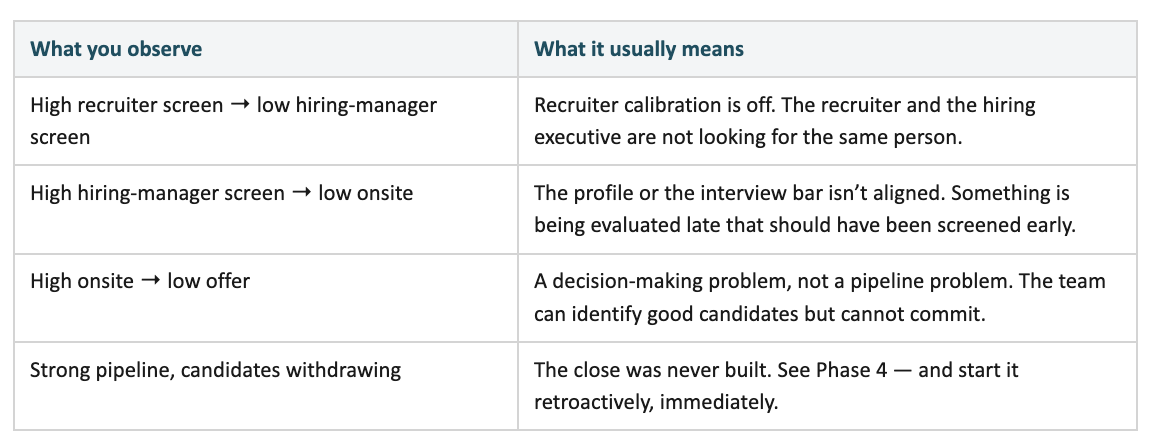
Resist the urge to set a single conversion benchmark — 30% at every stage, or anything like it. It sounds precise and is easy to challenge, because healthy conversion varies enormously by stage, by role, and by market. Read conversion as a diagnostic signal, not a grade. However, for scaled hiring (for instance, when making multiple Director-level engineering hires), setting rough benchmarks based on historical role data can provide valuable guidance.
Artifact for Phase 3: Weekly Search Review
Thirty minutes. Same time every week. The recruiter and hiring executive should both be present.
Pipeline: who moved, who stalled, who went dark.
Conversions: stage-by-stage, read against the diagnostic table above.
Candidate feedback: what candidates are telling us about the role, the company, and the pitch.
Market feedback: what the market is telling us about comp, level, and realism.
Archetype performance: which profile is converting, which is not.
Blockers: what is slow, and who owns unblocking it by name and date.
Ownership is important here. Every executive search needs one named owner on each side. If the answer to “who owns this?” is “we all do,” the search is already drifting.
Phase 4: Close
Leadership candidates evaluate you at least as aggressively as you evaluate them. Waiting until the offer to start selling is the most common way strong searches lose their best candidate. Know the answers to these early:
Why would an exceptional person leave their current job for this one?
What can this role give them that their current role cannot?
Who besides the founder should be selling them — an investor, a board member, a future peer, a customer?
Write these down before the first conversation. If you cannot answer the first one convincingly, the problem is the role, not the pipeline.
References are diligence, not validation
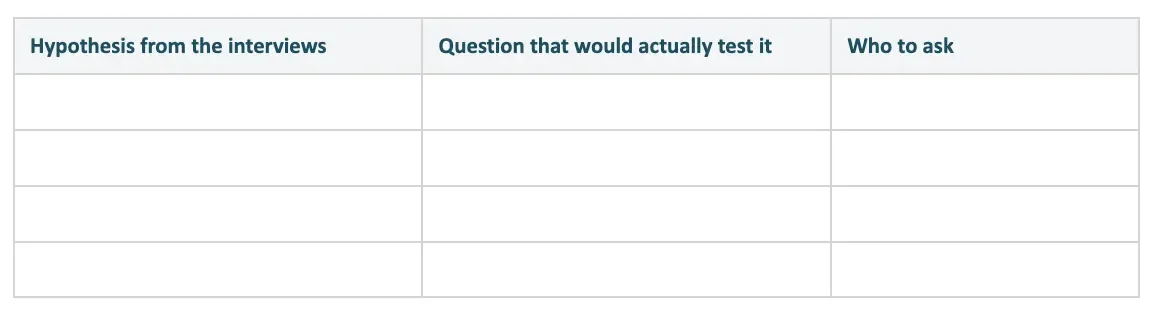
For leadership hires, references should not be a box you check after you’ve already decided. They should test specific hypotheses that emerged during the interviews.
Weak: “Would you work with them again?”
Strong: “We think this person is exceptional at recruiting but may struggle managing senior leaders who have run bigger orgs than they have. Tell me about a time you saw that tested.”
Backchannel references are often the most useful input available — use them where appropriate and lawful, and be deliberate about candidate consent and timing.
Artifact for Phase 4: Close Plan
Founders and hiring managers oftentimes take the close for granted. Meaning, they assume a candidate is both “ready” to receive an offer and “ready” to decide on said offer. By the time a hiring decision has been made (hire, no hire, we need more signal), a recruiter should be able to confidently answer these questions:
What are this person’s non-negotiables to consider the role (location, cash minimum, specific scope, etc.)?
Is this person still gettable? Have any circumstances changed during the interview process that should make us revisit their candidacy? Maybe they’ve received a competing offer that’s 2x the cash that we can realistically offer? Have they mentioned losing interest in the company? The domain? Are they suddenly unwilling to relocate?
Are they ready to receive an offer and make a decision in a realistic timeline? Don’t leave offers out in the open. Chances are, if a candidate says they aren’t ready to make a decision on your offer, they may still be shopping around. Chances are, you may not be their first choice.
Can the company afford to not hire this candidate?
If the company wants to hire a candidate, it’s time for a recruiter to go into recon mode. Someone (either the founder, hiring manager, or recruiter) should be able to gauge whether a candidate wants the job and would take the job. Ask:
Why would an exceptional person leave their current job for this?
What this role offers that their current one cannot?
Who is on the selling team, besides the founder?
Artifact for Phase 4: Reference Hypotheses
Fill this in after the onsite, before the reference calls.
The loop
Everything above connects back to a single idea. Exploratory conversations, archetypes, sprints, conversion data, calibration checkpoints, the 60-day reset — they are all mechanisms for the same thing:
The goal of an executive search is not to execute against the initial job description. It is to continuously increase the company’s confidence about what it needs, while simultaneously increasing the quality of the candidate pool.
If a week of searching increased neither your confidence nor your pool, that week didn't work, no matter how many candidates you spoke to. That is the only scoreboard that matters.