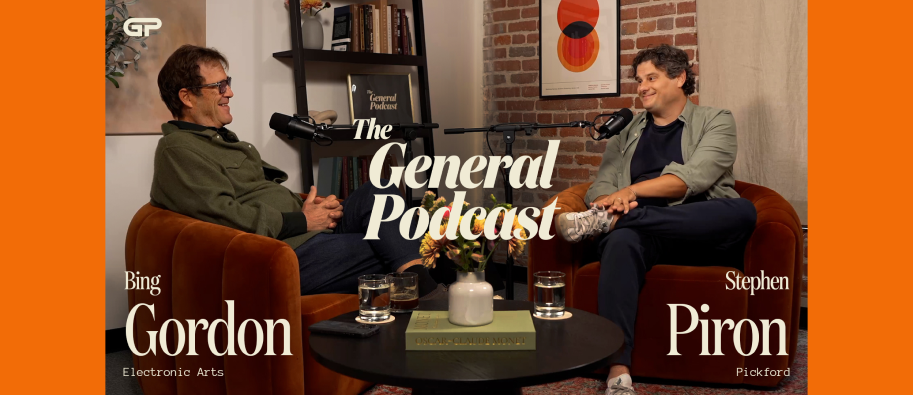
On Reinventing Storytelling with Bing Gordon (EA) x Stephen Piron (Pickford)

Listen:
🎧 Spotify
🍎 Apple
🎬 YouTube
The General Podcast is back! And what an appropriate week for this episode, as “storytelling” has become the skillset du jour among startups and tech companies alike, according to the Wall Street Journal. This episode brings together two founders who have totally reimagined storytelling formats throughout their careers: Bing Gordon and Stephen Piron.
Bing joined Electronic Arts in its earliest days as Chief Creative Officer and helped build it into the gaming powerhouse it is today. He was one of the first believers that interactive media could be a true art form, and over his career he shaped iconic games like The Sims, Madden, and Farmville. Few people have thought harder about what makes a story truly work.
Stephen is the founder of Pickford, a new kind of studio where the audience drives the plot in real time. His big idea is that if you scream at the TV, the TV “should scream back.” Before Pickford, Stephen built the world’s first deepfake (the Joe Rogan one) while working on his previous startup, Dessa, which was eventually acquired by Square.
Right off the bat, you’ll hear them dive into one of the most famous ad campaigns in tech history—EA’s “Can a Computer Make You Cry?” Bing shares the story behind that ad and Stephen admits he has it framed on his office wall.
From there, they get into the multiple reinventions of Hollywood, how you build character bibles and narrative arcs in the age of AI and why hits are always flukes until they’re not.
It’s a conversation about what it really takes to build an interactive platform that changes the way stories get made. You’ll learn:
The origin story of the iconic “Can a computer make you cry?” ad and why it mattered more than any product marketing
Why Electronic Arts once believed it would become “the new Hollywood” and what that taught Bing about storytelling
Why most AI storytelling efforts fail by trying to make old stories cheaper instead of inventing new formats
Why character bibles and narrative guardrails matter more than prompts
How Pickford is borrowing from centuries-old storytelling structures and updating them for real-time interaction
Why hits still matter more than platforms (and why every platform eventually needs one)
How AI might actually create more work for storytellers, not less
How Pickford worked with SAG to design a new, AI-era compensation model for voice actors
Referenced in this episode:
Adventures in the Screen Trade by William Goldman
Steve Jobs and the “reality distortion field”
The Startup of You by Reid Hoffman
Where to find Bing Gordon:
X (Twitter): @bingfish
Where to find Stephen Piron:
Pickford: pickford.ai
Up Next
Partnering with Minerva
Building the context layer for consumer marketing


Meet Dan Pupius, TheGP’s CTO
An update to our engineering org

